
Insomnia Recovery: The Science-Backed Roadmap to Rebuilding Your Sleep
A step-by-step guide to reclaiming restful nights without pills, based on behavioral sleep medicine
📖 A note from us → We spent weeks digging through the clinical research on insomnia recovery so you don’t have to. Here is what actually works: stimulus control, sleep restriction, and cognitive restructuring — the core components of CBT-I.
⚕️ Disclaimer: We are affiliate marketers, not doctors or sleep specialists. This guide is for educational purposes. Always consult a healthcare provider for persistent sleep issues.
📝 Editorial & Review Policy
This article was prepared by the DeepSleepAid editorial team based on publicly available research. While no individual medical professional has reviewed this specific article, all information is drawn from:
- Published peer-reviewed studies on CBT-I and behavioral sleep medicine (citations provided below)
- Clinical guidelines from the American Academy of Sleep Medicine
- Publicly available research from the NIH and PubMed Central
We have not personally reviewed original research data. This guide synthesizes publicly available information for educational purposes.
Always consult a licensed healthcare provider before starting any new treatment.
📑 Table of Contents
- Understanding Your Sleep Drive
- Step 1: Reset Your Sleep Schedule
- Step 2: Rebuild the Bed-Sleep Connection
- Step 3: Restrict Time in Bed
- Step 4: Manage the Mental Game
- Step 5: Optimize Your Sleep Environment
- 🧮 Sleep Efficiency Calculator
- 🎯 Insomnia Recovery Readiness Quiz
- Sleep Support Products
- Frequently Asked Questions
- About This Guide
⚕️ Medical Disclaimer: This information is for educational purposes only and is not medical advice. Consult your doctor before starting any sleep treatment. These products are not intended to diagnose, treat, cure, or prevent any disease.
Understanding Your Sleep Drive
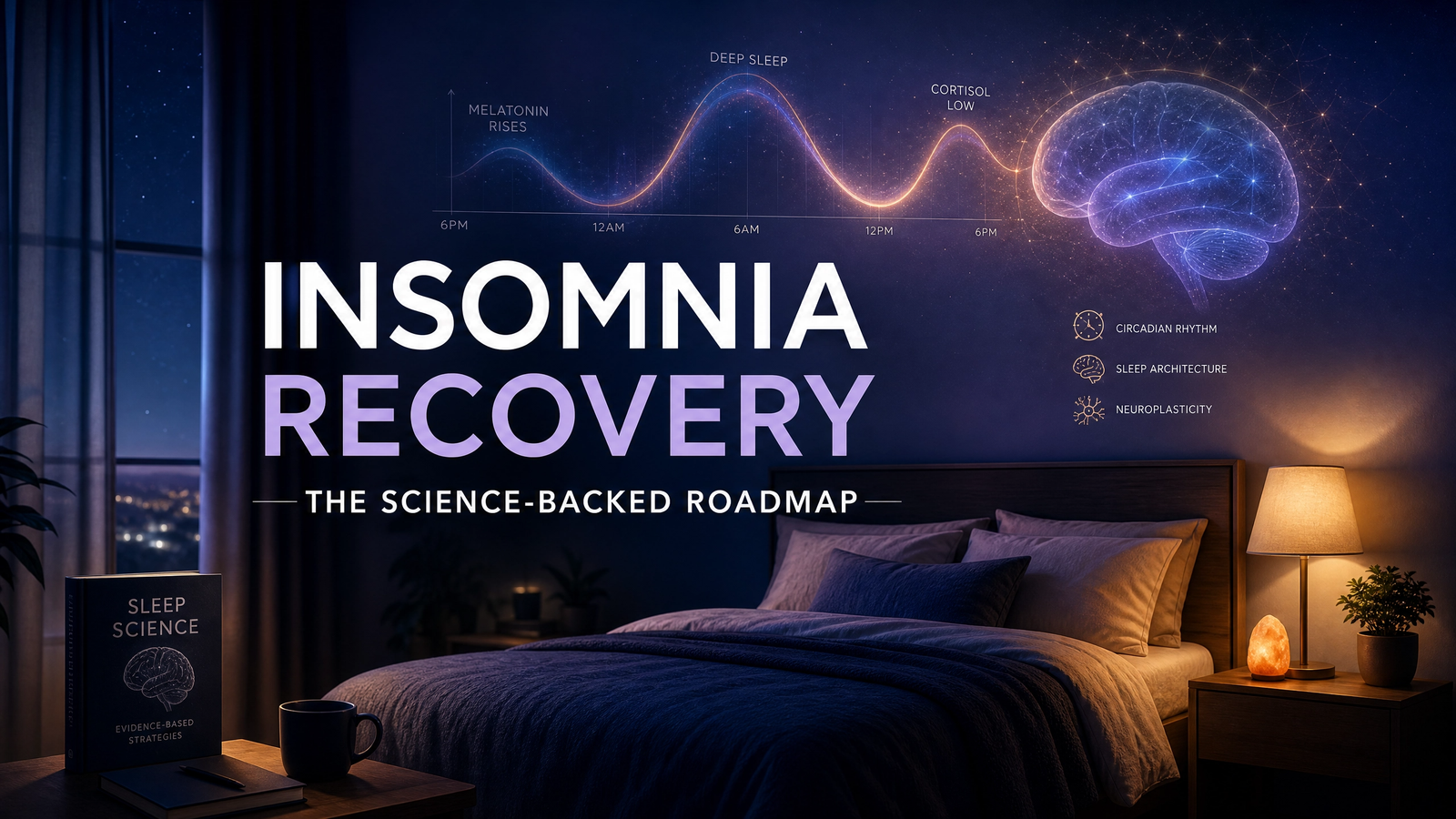
If you are looking for insomnia recovery, understanding your sleep drive is the first step. Your body has two systems that control sleep. The first is sleep drive, also called homeostatic sleep pressure. The longer you stay awake, the stronger this drive becomes. The second is your circadian rhythm, the internal clock that tells you when to be alert and when to rest. Insomnia often happens when these two systems fall out of sync.
When insomnia becomes chronic, the problem shifts from the original trigger to the behaviors you develop around sleep. You start going to bed earlier to catch up. You lie in bed awake for hours. You sleep in on weekends. You nap. Each of these actions weakens your sleep drive and confuses your circadian rhythm, making the insomnia self-sustaining. Research suggests that this behavioral loop is the primary driver of chronic insomnia, not the original stressor that started it.
The insomnia recovery roadmap below targets these behavioral loops directly. It is based on the principles of cognitive behavioral therapy for insomnia, or CBT-I, which multiple studies indicate is the most effective long-term treatment for chronic insomnia. Unlike sleeping pills, which mask symptoms, CBT-I rebuilds the biological systems that govern healthy sleep.
For more sleep health information, explore our sleep hygiene tips guide, stress and anxiety relief guide, and natural sleep aids guide.
Step 1: Reset Your Sleep Schedule
The first and most important change for insomnia recovery is to fix your wake-up time. Pick a time you can maintain every single day, including weekends, and set an alarm. This anchors your circadian rhythm and builds consistent sleep pressure.
Do not try to go to bed earlier to compensate. Going to bed before you are sleepy is one of the biggest mistakes insomniacs make. It creates hours of wakefulness in bed, which trains your brain to associate the bed with frustration rather than sleep. Instead, stay up until you genuinely feel sleepy, even if that means a short night initially. The sleepiness is a sign that your sleep drive is strong enough to carry you into sleep quickly.
Most people need between 7 and 9 hours of sleep per night. If you are currently sleeping only 5 hours, start with a wake time that allows 6 hours in bed. You will not sleep the full 6 hours at first, but the restricted window strengthens your sleep drive and reduces the time you spend awake in bed.
Step 2: Rebuild the Bed-Sleep Connection
This step is called stimulus control, and it is the behavioral backbone of insomnia recovery. The goal is simple: your bed should be associated with sleep and nothing else. Right now, if you have insomnia, your brain likely associates the bed with worry, planning, and frustration.
Follow these rules strictly for two weeks. First, use your bed only for sleep and intimate activities. No reading, no phone scrolling, no work, no eating. Second, if you are awake in bed for more than 20 minutes, get up and go to another room. Do something calm and boring under dim light. Return to bed only when you feel sleepy again. Third, if you wake up in the middle of the night and cannot fall back asleep within 20 minutes, get up again. Repeat the process. Fourth, do not watch the clock. Turn it away from you. Clock-watching creates performance anxiety that keeps you awake.
These rules feel counterintuitive. You may worry that getting up will make you more awake. In reality, staying in bed while awake is what perpetuates insomnia. Getting up breaks the association and preserves the bed as a sleep-only zone. Studies suggest that stimulus control is one of the most effective single interventions for insomnia.
Step 3: Restrict Time in Bed
Sleep restriction therapy sounds scary, but it is one of the most powerful tools in insomnia recovery. The principle is to temporarily match your time in bed to your actual sleep time, then gradually expand it as your sleep becomes more efficient.
Start by keeping a sleep diary for one week. Record what time you go to bed, what time you fall asleep, what time you wake up, and what time you get out of bed. Calculate your average sleep time. If you are in bed for 8 hours but only sleeping 5, your sleep efficiency is 62.5 percent. The goal is to raise this above 85 percent.
Set your time in bed to match your average sleep time, with a minimum of 5.5 hours. If you average 5 hours of sleep, spend 5.5 hours in bed. Set a fixed wake time and count backward to find your bedtime. You will feel tired at first, but this builds powerful sleep pressure. Once your sleep efficiency rises above 85 percent for a week, add 15 minutes to your time in bed. Continue adding 15 minutes every week until you reach your target sleep duration. Research indicates that sleep restriction therapy can produce significant improvements within 4 to 8 weeks.
Step 4: Manage the Mental Game
The thoughts that run through your mind at night are not random. They are part of the insomnia cycle. Worry about sleep creates arousal, which prevents sleep, which creates more worry. Breaking this cycle requires addressing the mental habits that sustain it.
First, schedule worry time. Set aside 15 minutes in the early evening to write down everything you are concerned about. When worries pop up at night, remind yourself that you have already addressed them during worry time. Second, challenge catastrophic thoughts. Instead of thinking “I will be ruined if I do not sleep tonight,” replace it with “I have functioned on poor sleep before, and I will manage tomorrow regardless.” Third, practice relaxation techniques. Progressive muscle relaxation, diaphragmatic breathing, and body scan meditation can lower physiological arousal. Fourth, accept wakefulness. Paradoxically, the harder you try to force sleep, the more elusive it becomes. Accepting that you are awake, without fighting it, reduces the anxiety that keeps you awake.
Cognitive restructuring, the process of changing these thought patterns, is a core component of CBT-I. Some studies suggest that addressing cognitive factors alone can improve sleep quality in individuals with insomnia.
Step 5: Optimize Your Sleep Environment
Your bedroom should be a cave. Cool, dark, and quiet. The ideal temperature for sleep is between 60 and 67 degrees Fahrenheit, or 15 to 19 degrees Celsius. A cool room helps your body temperature drop, which is a signal that initiates sleep. Use blackout curtains or an eye mask to eliminate light. Even small amounts of light can suppress melatonin production. Use earplugs or a white noise machine if noise is an issue. Remove all electronic devices from the bedroom. The blue light from screens suppresses melatonin, and the mental stimulation of content keeps your brain active.
Limit caffeine to before noon. Caffeine has a half-life of about 5 hours, meaning that a cup of coffee at 2 PM still has half its caffeine in your system at 7 PM. Avoid alcohol within 3 hours of bedtime. While alcohol may make you feel drowsy, research suggests it fragments sleep and reduces REM sleep quality. Avoid heavy meals within 2 hours of bed. Digestion raises body temperature and can cause discomfort. Exercise regularly, but finish vigorous activity at least 3 hours before bedtime.
🧮 Sleep Efficiency Calculator
Calculate your sleep efficiency to see if sleep restriction therapy may help
Your Sleep Efficiency Results
🎯 Are You Ready to Recover from Insomnia?
5 questions to assess whether you are prepared for CBT-I based recovery
1. How committed are you to following a strict sleep schedule for 4 weeks?
2. Can you handle feeling more tired for the first 1-2 weeks of treatment?
3. How willing are you to get out of bed when you cannot sleep?
4. How long have you had insomnia?
5. Have you tried sleeping pills or supplements without lasting success?
Your Recovery Readiness Assessment
Sleep Support Products for Recovery
While the behavioral steps above are the foundation of insomnia recovery, some people benefit from additional sleep support during the adjustment period. The following products may help you fall asleep faster and maintain sleep while your sleep drive rebuilds.
🔗 Affiliate Disclosure: We earn a commission if you purchase through this link, at no extra cost to you.
🌙 Sleep Restore Pro
A natural sleep support formula designed to help you fall asleep faster and experience deeper, more restorative sleep.
According to the product label, the manufacturer states that Sleep Restore Pro combines melatonin with calming botanicals and essential minerals to support your body’s natural sleep-wake cycle. The formula includes ingredients that may help reduce nighttime awakenings and promote a sense of calm before bed.
During the first two weeks of sleep restriction therapy, you may feel more tired than usual as your sleep drive rebuilds. Many users report that Sleep Restore Pro helps them fall asleep more quickly during this adjustment period, which is critical because the faster you fall asleep, the more efficient your time in bed becomes. The manufacturer recommends taking it 30 minutes before your desired bedtime as part of a consistent sleep routine.
Learn More About Sleep Restore Pro →Claims about this specific product are based on manufacturer-provided information. Individual results vary. This product is not intended to diagnose, treat, cure, or prevent any disease.
🔗 Affiliate Disclosure: We earn a commission if you purchase through this link, at no extra cost to you.
💤 Dream Deep Complex
A premium sleep formula designed to support deep, uninterrupted sleep cycles and improve overall sleep quality.
According to the product label, the manufacturer states that Dream Deep Complex focuses on enhancing the quality of sleep rather than just helping you fall asleep. The formula contains ingredients that may support the production of sleep-promoting neurotransmitters and help maintain stable sleep architecture throughout the night.
As your sleep efficiency improves through CBT-I principles, the quality of your sleep becomes more important than the quantity. Deep, continuous sleep is what restores your body and mind. Many users report waking up feeling more refreshed and experiencing less daytime grogginess after using Dream Deep Complex consistently. The manufacturer suggests that the formula works best when combined with a regular sleep schedule and a dark, cool sleep environment.
Learn More About Dream Deep Complex →Claims about this specific product are based on manufacturer-provided information. Individual results vary. This product is not intended to diagnose, treat, cure, or prevent any disease.
For more natural sleep support, explore our guide to essential oils for sleep and natural sleep aids guide.
Both products are intended to complement, not replace, the behavioral strategies outlined in this guide. They work best when combined with consistent sleep scheduling, stimulus control, and the other interventions discussed above. Individual results vary, and these products are not intended to diagnose, treat, cure, or prevent any disease.
Frequently Asked Questions About Insomnia Recovery
Most people see noticeable improvement within 2 to 4 weeks of consistent CBT-I practice. Full insomnia recovery, defined as sleeping well without ongoing effort, typically takes 6 to 8 weeks. The first 1 to 2 weeks are often the hardest because sleep restriction creates temporary sleepiness. Sticking with the program through this phase is essential for long-term success.
Yes. CBT-I, which is entirely non-pharmacological, is considered the gold standard treatment for chronic insomnia. Research suggests it produces longer-lasting results than sleeping pills and addresses the root behavioral causes rather than just masking symptoms. Many people achieve full insomnia recovery using only the techniques described in this guide.
Yes, temporarily. Sleep restriction therapy intentionally creates mild sleep deprivation in the first 1 to 2 weeks to build stronger sleep pressure. You may feel more tired during the day. This is normal and expected. The sleepiness is a sign that your sleep drive is strengthening. By week 3 or 4, most people start sleeping more deeply and feeling better during the day.
Do not force yourself to stay awake if you are genuinely sleepy before your scheduled bedtime. The goal is to go to bed when sleepy, not to exhaust yourself. However, avoid going to bed out of habit or boredom. If you feel sleepy 30 minutes before your scheduled bedtime, it is fine to go to bed early. If you are not sleepy at your scheduled bedtime, stay up until you are, even if that means a slightly later night.
No. Napping reduces your sleep drive and undermines the effectiveness of sleep restriction therapy. If you feel extremely tired during the day, take a brief walk, splash cold water on your face, or do light stretching. Avoid lying down or closing your eyes for more than a few minutes. Once your insomnia recovery is complete, you may be able to reintroduce short naps, but avoid them during the recovery period.
A simple sleep diary is more useful than a wearable tracker during CBT-I. Track your bedtime, estimated sleep onset time, wake time, and time out of bed. Calculate sleep efficiency manually. Consumer sleep trackers can be inaccurate and may create anxiety about sleep stages and scores. Focus on how you feel during the day rather than device-generated metrics.
Bad nights happen. Do not abandon your schedule because of one poor night. Stick to your fixed wake time regardless of how little you slept. Do not sleep in, do not nap, and do not go to bed earlier the next night. Consistency is what rebuilds your sleep system. One bad night is a temporary setback, not a failure in your insomnia recovery journey.
It is best to avoid alcohol during the recovery period. Alcohol fragments sleep, reduces REM sleep, and can cause early morning awakenings. It also interferes with the sleep drive you are trying to rebuild. If you choose to drink, limit it to one drink and finish at least 3 hours before bedtime.
📚 About This Guide
This guide was created by the DeepSleepAid editorial team using information drawn from publicly available sources, including:
- Peer-reviewed studies on CBT-I and behavioral sleep medicine (citations provided throughout)
- Publicly available clinical guidelines from the American Academy of Sleep Medicine
- Safety data from the NIH Office of Dietary Supplements and regulatory bodies
We have not personally reviewed original research data. This guide synthesizes publicly available information for educational purposes.
We do not accept payment for positive reviews. Product recommendations are based on ingredient quality, dosing transparency, and alignment with published sleep research. This guide is updated periodically as new information becomes available.