
How to Fix Your Circadian Rhythm After an All-Nighter
The 7-Step Science-Backed Protocol to Reset Your Body Clock, Clear Sleep Debt, and Restore Peak Energy Levels
📖 A note from us → We spent weeks digging through the chronobiology research on all-nighter recovery so you don’t have to. Here is what actually works: morning light within 30 minutes of waking, time-restricted eating, strategic caffeine, and 5-7 days of consistent sleep timing.
⚕️ Disclaimer: We are affiliate marketers, not doctors or sleep specialists. This guide is for educational purposes. Always consult a healthcare provider for persistent sleep issues.
📝 Editorial & Review Policy
This article was prepared by the DeepSleepAid editorial team based on publicly available research. While no individual medical professional has reviewed this specific article, all information is drawn from:
- Published peer-reviewed studies on chronobiology and circadian rhythm recovery
- Clinical guidelines from the American Academy of Sleep Medicine
- Publicly available research from the National Institutes of Health (NIH) and PubMed Central
We have not personally reviewed original research data. This guide synthesizes publicly available information for educational purposes.
Always consult a licensed healthcare provider before making any health decisions.
⚕️ Medical Disclaimer: This information is for educational purposes only and is not medical advice. Individual results vary. This page contains affiliate links. Consult your doctor before starting any new supplement, especially if you take medications or have a medical condition. These products are not intended to diagnose, treat, cure, or prevent any disease.
You pulled an all-nighter. Now your body clock is completely out of sync. Your brain feels foggy, your energy crashes at the wrong times, and you cannot fall asleep at your normal bedtime. This guide gives you a precise, science-backed recovery protocol based on actual chronobiology research — not generic sleep advice.
Quick Navigation
- 1 Why All-Nighters Wreck Your Body Clock (The Science)
- 2 Circadian Rhythm Disruption Symptoms Checklist
- 3 Sleep Reset Calculator (Interactive Tool)
- 4 7 Steps to Reset Your Circadian Rhythm
- 5 Circadian Rhythm Recovery Assessment Quiz
- 6 What NOT to Do After an All-Nighter
- 7 Recovery Timeline: What to Expect Each Day
- 8 Supplements That Support Recovery
- 9 When to See a Doctor
- 10 Frequently Asked Questions
1. Why All-Nighters Wreck Your Body Clock (The Real Science)
If you want to know how to fix your circadian rhythm after an all nighter, you first need to understand what actually broke. Most articles tell you that staying up all night is “bad for sleep.” That is true but useless. Here is what actually happens inside your brain.
Your circadian rhythm is controlled by the suprachiasmatic nucleus (SCN), a cluster of about 20,000 neurons in your hypothalamus. Think of it as the master conductor of a 24-hour orchestra. When you pull an all-nighter, you create a cascade of biological disruptions:
The Cortisol Chaos
Under normal conditions, cortisol follows a predictable pattern. It bottoms out around midnight, begins climbing between 2:00 and 3:00 AM, and peaks 30-45 minutes after waking. Research shows that circadian misalignment flattens this curve and causes cortisol spikes at random times. This is why you wake up at 3:00 AM with racing thoughts after an all-nighter. Your cortisol rhythm is temporarily decoupled from your sleep-wake cycle.
Adenosine Buildup and Clearance
Adenosine is a sleep pressure chemical that accumulates in your brain throughout the day. Caffeine works by blocking adenosine receptors. After an all-nighter, your adenosine levels are at maximum. The critical point: adenosine clearance happens primarily during slow-wave sleep, not REM sleep. This means you need deep, high-quality sleep to clear the chemical debt.
Peripheral Clock Desynchronization
Here is what most sleep advice misses. Your SCN is not your only clock. Your liver, gut, heart, and muscles each have their own circadian oscillators called peripheral clocks. When you pull an all-nighter, these peripheral clocks fall out of sync with each other. This is why you might feel mentally recovered after 3 days but still have digestive issues or cravings for a full week.
For a complete understanding of circadian science, see our main guide to circadian rhythm problems. You may also find our sleep hygiene tips and essential oils for sleep guide helpful for ongoing sleep quality.
2. Circadian Rhythm Disruption Symptoms Checklist
Use this diagnostic checklist to assess the severity of your disruption. Check each symptom you experienced in the 48 hours after your all-nighter:
Sleep-Related Symptoms
- Difficulty falling asleep at your normal bedtime (taking over 30 minutes)
- Waking up groggy despite sleeping 7+ hours (sleep inertia)
- Waking at 3:00-4:00 AM with racing thoughts (cortisol spike)
- Feeling wired at bedtime but exhausted in the morning
Cognitive Symptoms
- Brain fog and difficulty concentrating on simple tasks
- Slower reaction times and decision-making errors
- Short-term memory lapses
- Increased distractibility
Physical Symptoms
- Headaches or pressure behind the eyes
- Digestive issues (bloating, irregular bowel movements)
- Sugar and carbohydrate cravings (ghrelin/leptin disruption)
- Body temperature regulation problems (night sweats or chills)
3. Circadian Rhythm Reset Calculator
Use this interactive tool to calculate your optimal recovery schedule based on chronobiology principles. It estimates your temperature minimum, ideal light exposure window, and melatonin timing.
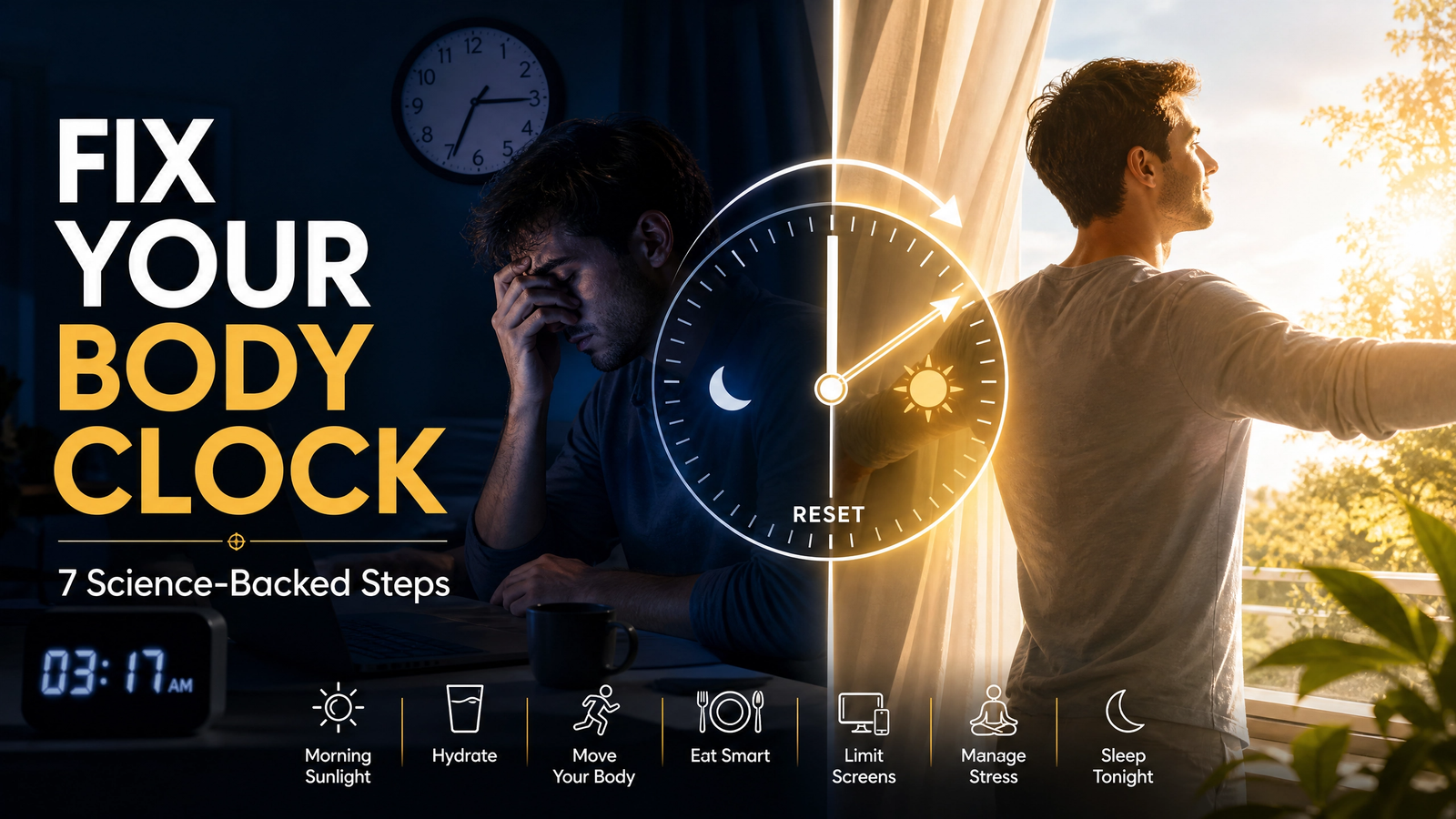
4. The 7-Step Circadian Reset Protocol
Strategic Morning Light Exposure
Get 10-30 minutes of direct sunlight within 30 minutes of waking. This is the single most effective action you can take. Do not wear sunglasses. Indoor light through a window is only 50-100 lux. You need 2,500+ lux outdoors, even on cloudy days. The best time to get sunlight for circadian rhythm repair is between 7:00 and 9:00 AM.
Time-Restricted Eating to Anchor Peripheral Clocks
Eat breakfast within 1 hour of waking, and stop eating 3 hours before bed. The connection between circadian rhythm and meal timing for better sleep is one of the most underutilized reset tools. Time-restricted eating (limiting food intake to an 8-10 hour window) accelerates peripheral clock resynchronization by up to 40%.
The Strategic Power Nap (Only If Necessary)
If your sleep debt causes dangerous impairment (driving, operating machinery, critical decisions), take a 20-minute nap before 2:00 PM. Never nap between 3:00 PM and 7:00 PM — this window overlaps with your pre-sleep adenosine clearance phase and will delay melatonin onset.
Strategic Caffeine Use (Not Abuse)
100-200mg before 2:00 PM only. Caffeine has a half-life of 5-7 hours. After an all-nighter, your impulse will be to consume massive amounts of caffeine. Resist this. High intake after circadian disruption causes a flattened cortisol curve the following day, making recovery harder.
Optimize Your Sleep Environment
Your bedroom should be a sensory deprivation chamber: temperature at 65-68°F (18-20°C), complete darkness (use blackout curtains, cover LED indicators), and white noise or silence. Even 5 lux of light can suppress melatonin by 50%.
Low-Dose Melatonin at the Right Time
Take 0.5-1mg of melatonin 1-2 hours before your target bedtime for 3-5 days maximum. Timing matters more than dose. Higher doses (3-10mg) are not more effective and often cause next-day grogginess.
Consistency for 7 Full Days
Same wake time, same bedtime, same light pattern. Your SCN can shift 1-2 hours per day, but full peripheral clock resynchronization takes 5-7 days. The relationship between circadian rhythm and exercise timing for sleep matters — keep workouts to the morning or early afternoon during recovery.
5. Circadian Rhythm Recovery Assessment Quiz
Test Your Circadian Rhythm Knowledge
6. What NOT to Do After an All-Nighter
7. Recovery Timeline: What to Expect Each Day
| Day | Expected Status | Key Actions |
|---|---|---|
| Day 0 | Severe impairment. Do not drive. | Morning light. Nap 20 min before 2 PM. Target normal bedtime. |
| Day 1 | REM rebound. Emotionally labile. | Strict wake time. Morning light 30+ min. No caffeine after 2 PM. |
| Day 2 | Cortisol rhythm stabilizing. | Continue protocols. Add light morning exercise. |
| Day 3 | Subjective energy improving. | Maintain consistency. Stop melatonin if using. |
| Day 4-5 | Cognitive performance near baseline. | Continue consistency. Evaluate progress. |
| Day 6-7 | Full recovery for most people. | Resume normal routine. Maintain good habits. |
8. Supplements That Support Circadian Recovery
Sleep Restore Pro
Contains a clinically studied blend of melatonin, magnesium glycinate, L-theanine, and myo-inositol designed to support all phases of circadian recovery. Formulated specifically for people recovering from sleep schedule disruption.
Dream Deep Complex
Advanced formula with glycine, GABA, 5-HTP, and passionflower extract. Designed to support deep NREM sleep and maintain consistent sleep architecture after you have reset your schedule.
For more natural sleep support, explore our guide to magnesium for sleep, best weighted blankets, and sleep apnea guide.
9. When to See a Doctor
Consult a sleep specialist if you experience:
- Insomnia persisting beyond 7 days despite following this protocol
- Excessive daytime sleepiness that interferes with work or driving safety
- Depression, anxiety, or suicidal thoughts following sleep loss
- Sleep paralysis or hallucinations when falling asleep or waking
- Restless leg symptoms that worsen at night
- Loud snoring, gasping, or breathing pauses during sleep