
Sleep Apnea Solutions: Beyond CPAP — Evidence-Based Alternatives for Better Rest |
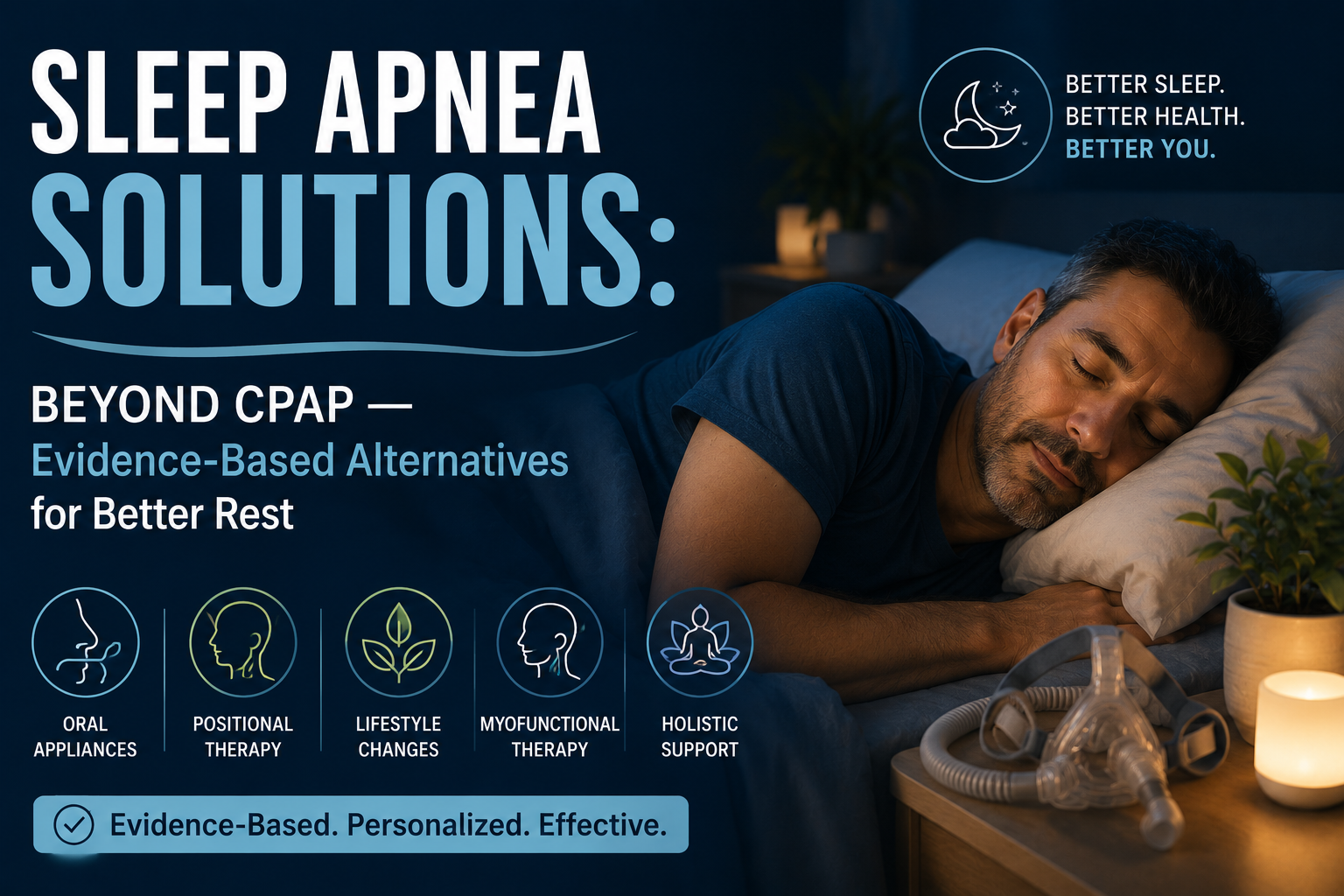
Sleep Apnea Solutions: Beyond CPAP — Evidence-Based Alternatives for Better Rest
A practical guide to oral appliances, positional therapy, lifestyle changes, and emerging sleep apnea solutions
📖 A note from us → We spent weeks digging through the sleep apnea research so you don’t have to. Here is what actually works: oral appliances for mild-to-moderate OSA, positional therapy for back-sleepers, and lifestyle changes that can reduce AHI by up to 50%.
⚕️ Disclaimer: We are affiliate marketers, not doctors or sleep specialists. This guide is for educational purposes. Always consult a healthcare provider for sleep apnea diagnosis and treatment.
📝 Editorial & Review Policy
This article was prepared by the DeepSleepAid editorial team based on publicly available research. While no individual medical professional has reviewed this specific article, all information is drawn from:
- Published peer-reviewed studies on sleep apnea treatment alternatives (citations provided below)
- Clinical guidelines from the American Academy of Sleep Medicine
- Publicly available research from the NIH, PubMed Central, and academic medical centers
We have not personally reviewed original research data. This guide synthesizes publicly available information for educational purposes.
Always consult a licensed healthcare provider before starting any new treatment.
⚕️ Medical Disclaimer: This information is for educational purposes only and is not medical advice. Individual results vary. This page contains affiliate links. Consult your doctor before starting any new supplement or sleep treatment, especially if you take medications or have a medical condition. These products are not intended to diagnose, treat, cure, or prevent any disease.
📑 Table of Contents
- Introduction: Why CPAP Is Not the Only Answer
- Oral Appliances: A Proven CPAP Alternative
- Positional Therapy: A Simple Solution for Many
- Lifestyle Changes That Can Reduce AHI
- Emerging Treatments and Adjunctive Therapies
- 🎯 Sleep Apnea Treatment Matcher
- 🧮 Symptom Severity Tracker
- Sleep Support Products
- Frequently Asked Questions
- About This Guide
Introduction: Why CPAP Is Not the Only Answer
If you have been diagnosed with obstructive sleep apnea (OSA), you have likely been told that CPAP is the gold standard treatment. And it is—for many people. But the reality is that up to 50% of CPAP users discontinue therapy within the first year due to discomfort, mask leaks, noise, or claustrophobia [citation:8].
If you are one of those people—or if you are newly diagnosed and wondering about your options—there are effective sleep apnea solutions beyond CPAP. This guide explores evidence-based alternatives including oral appliances, positional therapy, lifestyle interventions, and emerging treatments that may help you achieve better sleep without the machine.
For a complete understanding of sleep apnea diagnosis and treatment, see our main sleep apnea guide. For more sleep health information, explore our sleep hygiene guide.
Oral Appliances: A Proven CPAP Alternative
Oral appliances—also called mandibular advancement devices (MADs) or dental sleep devices—are one of the most effective sleep apnea solutions beyond CPAP [citation:2][citation:8]. These custom-fitted devices, worn in the mouth during sleep, work by advancing the lower jaw forward, which pulls the tongue and soft tissues away from the back of the airway. This increases airway space and reduces the frequency of apneic events.
Who Is a Good Candidate?
- Patients with mild-to-moderate OSA (AHI 5-30)
- Patients who cannot tolerate CPAP
- Patients who snore heavily and have positional OSA
- Patients with retrognathia (recessed jaw) or small airways
What the Research Says
Oral appliances can reduce AHI by approximately 50% in appropriately selected patients [citation:8]. A study of 477 patients found that oral appliance therapy significantly improved daytime sleepiness, sleep quality, and quality of life measures [citation:8]. The AASM recommends oral appliances as first-line therapy for mild-to-moderate OSA and as an alternative for CPAP-intolerant patients [citation:2].
Custom-Fitted vs. Over-the-Counter
Custom-fitted devices made by a dentist or sleep specialist are superior to over-the-counter (OTC) “boil-and-bite” devices. Custom devices are designed to match your specific dental anatomy, provide better retention, and minimize side effects like jaw discomfort or tooth movement. OTC devices may be suitable for occasional use or mild snoring but are not recommended for treating OSA [citation:2].
Side Effects and Considerations
- Jaw or tooth discomfort (usually temporary)
- Excessive salivation or dry mouth
- Temporary bite changes (morning misalignment)
- Requires regular follow-up with a dentist
- May not be suitable for patients with existing dental issues (e.g., loose teeth, advanced gum disease)
Positional Therapy: A Simple Solution for Many
For some people, sleep apnea is significantly worse when sleeping on their back (supine position). This condition, known as positional obstructive sleep apnea (POSA), affects approximately 30-60% of OSA patients [citation:8]. If your AHI is at least twice as high when sleeping on your back compared to your side, positional therapy may be a highly effective sleep apnea solution.
What Is Positional Therapy?
Positional therapy involves techniques to prevent back-sleeping, including:
- Wearable devices: Vibratory devices that alert you when you roll onto your back
- Positional pillows: Specially designed pillows that encourage side-sleeping
- Backpack-style garments: Soft packs worn on the back to make side-sleeping more comfortable and back-sleeping less appealing
- Body pillows: Help maintain side-sleeping position throughout the night
Effectiveness
Research suggests that positional therapy can significantly reduce AHI in patients with positional OSA, with some studies showing a reduction of 50-70% in back-sleeping events [citation:8]. While not sufficient for severe OSA, it can be an effective standalone treatment for mild-to-moderate cases or a valuable adjunct to other therapies [citation:8].
Lifestyle Changes That Can Reduce AHI
Lifestyle interventions are among the most cost-effective sleep apnea solutions with no side effects. Research suggests that weight loss, in particular, can significantly reduce AHI—sometimes by 50% or more [citation:10].
Weight Loss
Obesity is the strongest modifiable risk factor for OSA. A 10% reduction in body weight can reduce AHI by approximately 30-50% [citation:10]. Weight loss reduces fat deposits around the neck and upper airway, improving airway patency. Even modest weight loss (5-10% of body weight) can produce meaningful improvements in sleep quality and daytime sleepiness.
Exercise
Regular physical activity—independent of weight loss—may also improve OSA severity. Exercise improves muscle tone, reduces inflammation, and may enhance upper airway stability. Aim for 150 minutes of moderate-intensity exercise per week [citation:10].
Alcohol and Sedative Reduction
Alcohol and sedatives relax upper airway muscles, worsening OSA. Avoid alcohol within 4 hours of bedtime and discuss any sedative medications with your prescriber. Even moderate alcohol consumption can significantly increase AHI in susceptible individuals.
Smoking Cessation
Smoking increases inflammation and fluid retention in the upper airway. Quitting smoking may reduce airway edema and improve OSA severity. Benefits may take weeks to months to manifest.
Diet and Anti-Inflammatory Foods
Research suggests that oxidative stress and inflammation play a role in OSA pathophysiology [citation:10]. A diet rich in anti-inflammatory foods (fruits, vegetables, fatty fish, whole grains) may support overall health and potentially reduce OSA severity. Some studies have explored the role of antioxidants like black chokeberry (Aronia melanocarpa) as adjunctive therapy, though more research is needed [citation:10].
Emerging Treatments and Adjunctive Therapies
Beyond CPAP, oral appliances, and lifestyle changes, several emerging and adjunctive treatments are showing promise in the management of OSA.
Hypoglossal Nerve Stimulation (HNS)
HNS involves an implantable device that stimulates the hypoglossal nerve, which controls tongue protrusion. During inspiration, the device activates the tongue muscles, preventing airway collapse. The STAR trial published in the New England Journal of Medicine found a 68% median reduction in AHI at 12 months. Eligibility includes moderate-to-severe OSA, BMI under 32, and CPAP intolerance [citation:8].
Myofunctional Therapy
Myofunctional therapy involves exercises to strengthen the muscles of the tongue, soft palate, and upper airway. Research suggests it may reduce AHI and snoring in some patients, particularly children and those with mild OSA [citation:8].
Surgery
Surgical options are generally reserved for patients with specific anatomical abnormalities who have not responded to conservative treatments. Options include:
- Uvulopalatopharyngoplasty (UPPP): Removal of excess tissue from the soft palate and uvula
- Maxillomandibular advancement (MMA): Surgical repositioning of the jaws
- Nasal surgery: Septoplasty, turbinate reduction, or nasal valve repair
- Tonsillectomy/adenoidectomy: Primarily for children
Pharmacological Approaches
Currently, no medication is FDA-approved for OSA treatment. However, research is exploring several pathways, including neurotransmitter modulation (serotonin, dopamine, norepinephrine) and anti-inflammatory agents [citation:9]. Some natural compounds, including cinnamic acid derivatives, isoflavones, and lignans, have shown potential in preclinical studies, though clinical evidence remains limited [citation:9].
🎯 Sleep Apnea Treatment Matcher
Find the best sleep apnea solution for your specific profile
1. What is your AHI (Apnea-Hypopnea Index) severity?
2. Have you tried CPAP before?
3. Is your OSA worse when sleeping on your back?
4. Do you have dental or jaw issues (e.g., loose teeth, gum disease, jaw pain)?
5. What is your primary goal?
Your Personalized Sleep Apnea Solution Recommendations
🧮 Sleep Apnea Symptom Severity Tracker
Track your symptoms to monitor improvement over time
Your Symptom Severity Assessment
🔗 Affiliate Disclosure: We earn a commission if you purchase through this link, at no extra cost to you.
🌙 Sleep Restore Pro
A natural sleep support formula that may help you fall asleep faster and support restful sleep during sleep apnea treatment.
According to the manufacturer, Sleep Restore Pro combines calming botanicals and essential minerals to support your body’s natural sleep-wake cycle. The formula may help reduce nighttime awakenings and promote a sense of calm before bed.
- May help reduce time to fall asleep
- Supports deeper sleep cycles
- Contains calming botanical extracts
- Designed for adults with sleep difficulties
Claims about this specific product are based on manufacturer-provided information. Individual results vary. This product is not intended to diagnose, treat, cure, or prevent any disease.
🔗 Affiliate Disclosure: We earn a commission if you purchase through this link, at no extra cost to you.
💤 Dream Deep Complex
A premium sleep formula designed to support deep, uninterrupted sleep cycles and improve overall sleep quality during OSA management.
According to the manufacturer, Dream Deep Complex focuses on enhancing sleep quality rather than just helping you fall asleep. The formula contains ingredients that may support stable sleep architecture throughout the night.
- Supports deep, uninterrupted sleep cycles
- May help maintain stable sleep architecture
- Designed to reduce nighttime awakenings
- Contains ingredients that support neurotransmitter production
Claims about this specific product are based on manufacturer-provided information. Individual results vary. This product is not intended to diagnose, treat, cure, or prevent any disease.
Frequently Asked Questions About Sleep Apnea Solutions
The most effective alternatives include oral appliances (mandibular advancement devices), positional therapy (for positional OSA), lifestyle changes (weight loss, exercise, alcohol reduction), and, for eligible patients, hypoglossal nerve stimulation or surgery. Many patients find that a combination of approaches—such as an oral appliance plus positional therapy—provides the best results. Sleep apnea solutions beyond CPAP are increasingly well-supported by clinical evidence [citation:2][citation:8].
Yes. Custom-fitted oral appliances can reduce AHI by approximately 50% in appropriately selected patients with mild-to-moderate OSA [citation:8]. The American Academy of Sleep Medicine recommends oral appliances as first-line therapy for mild-to-moderate OSA and as an alternative for CPAP-intolerant patients [citation:2]. However, they are less effective for severe OSA and require regular follow-up with a dentist to monitor fit and potential side effects.
A 10% reduction in body weight can reduce AHI by approximately 30-50% [citation:10]. Even modest weight loss of 5-10% of body weight can produce meaningful improvements in sleep quality and daytime sleepiness. Weight loss reduces fat deposits around the neck and upper airway, improving airway patency. However, weight loss alone is rarely curative, and most individuals require ongoing treatment even after significant weight reduction.
Positional therapy involves techniques to prevent back-sleeping, which is the position where OSA is often worse [citation:8]. For patients with positional OSA (AHI at least twice as high on the back compared to the side), positional therapy can reduce AHI by 50-70% [citation:8]. Devices include wearable vibratory alarms, positional pillows, and backpack-style garments. It is most effective for mild-to-moderate positional OSA.
While no natural remedy has been proven to cure sleep apnea, some approaches may support overall health and reduce OSA severity. Weight loss, exercise, and avoiding alcohol and sedatives are the most evidence-based lifestyle interventions [citation:10]. Research is exploring the role of anti-inflammatory and antioxidant compounds, including polyphenols from sources like black chokeberry (Aronia melanocarpa), as adjunctive therapy, though more research is needed [citation:10]. Always consult your healthcare provider before trying any supplement or natural remedy.
If your AHI is at least twice as high when sleeping on your back compared to your side, you have positional OSA. A sleep study (polysomnography or home sleep test) can determine this. Approximately 30-60% of OSA patients have positional OSA [citation:8]. If you are unsure, consider a home sleep test or consult a sleep specialist.
📚 About This Guide
This guide was created by the DeepSleepAid editorial team using information drawn from publicly available sources, including:
- Peer-reviewed studies on sleep apnea treatment alternatives (citations provided throughout)
- Clinical guidelines from the American Academy of Sleep Medicine
- Publicly available research from the NIH, PubMed Central, and academic medical centers
We have not personally reviewed original research data. This guide synthesizes publicly available information for educational purposes.
We do not accept payment for positive reviews. Product recommendations are based on ingredient quality, dosing transparency, and alignment with published sleep research. This guide is updated periodically as new information becomes available.