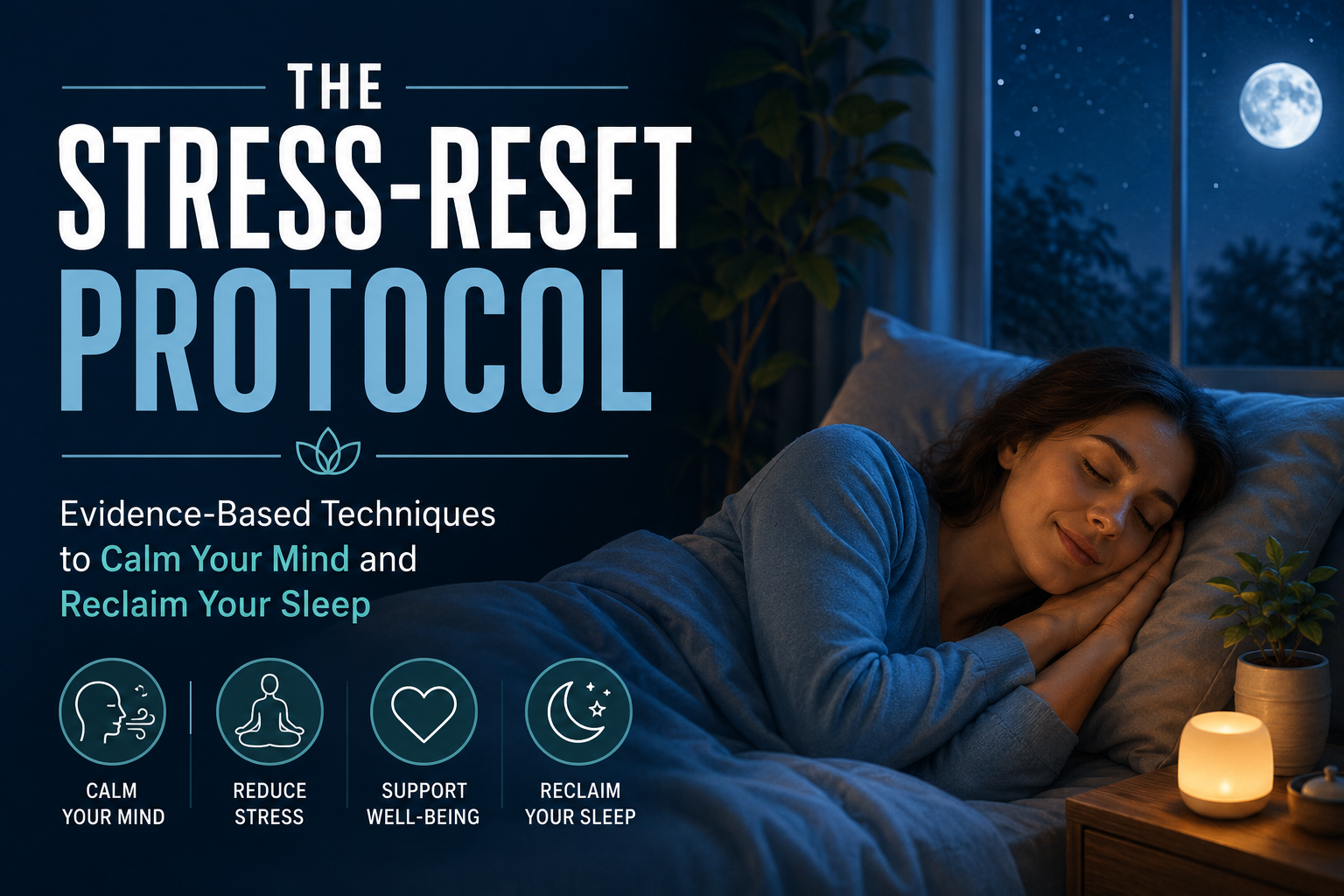

The Stress-Reset Protocol: Evidence-Based Techniques to Calm Your Mind and Reclaim Your Sleep
A practical, step-by-step guide to lowering cortisol, breaking the anxiety cycle, and restoring calm
📖 A note from us → We spent weeks digging through the stress research so you don’t have to. Here is what actually works: targeting your cortisol pattern, using micro-habits to interrupt the stress cycle, and building a personalized reset routine.
⚕️ Disclaimer: We are affiliate marketers, not doctors or therapists. This guide is for educational purposes. If you are in crisis, call 988 (US) or 111 (UK).
📝 Editorial & Review Policy
This article was prepared by the DeepSleepAid editorial team based on publicly available research. While no individual medical professional has reviewed this specific article, all information is drawn from:
- Published peer-reviewed studies on stress physiology and anxiety management (citations provided below)
- Clinical guidelines from the American Psychological Association and the Anxiety and Depression Association of America
- Publicly available research from the NIH and Harvard Health
We have not personally reviewed original research data. This guide synthesizes publicly available information for educational purposes.
Always consult a licensed healthcare provider before starting any new treatment or supplement.
⚕️ Medical Disclaimer: This information is for educational purposes only and is not medical advice. Individual results vary. This page contains affiliate links. Consult your doctor before starting any new supplement, especially if you take medications or have a medical condition. These products are not intended to diagnose, treat, cure, or prevent any disease.
📑 Table of Contents
- Introduction: Why Stress Feels Unstoppable
- Phase 1: Map Your Cortisol Pattern
- Phase 2: Build Your Micro-Habit Toolkit
- Phase 3: Design Your Daily Reset
- Phase 4: Protect Your Sleep
- 🧮 Cortisol Curve Quiz
- 🧮 Stress-Reset Planner
- Supplements That Support the Reset
- Frequently Asked Questions
- About This Guide
Introduction: Why Stress Feels Unstoppable
If you are looking for stress and anxiety relief, you have likely noticed something frustrating: stress is not just a feeling. It is a physical, physiological, and behavioral loop. Your heart races, your shoulders tense, your mind spins, and the harder you try to relax, the more elusive calm becomes.
This is not a failure of willpower. It is a failure of strategy.
Your body’s stress response evolved to handle short bursts of danger—not the constant, low-grade pressure of modern life. The result is a system stuck in overdrive, releasing cortisol and adrenaline even when no immediate threat exists. Over time, this chronic activation damages sleep, impairs concentration, and erodes mental health.
In this guide, we present a stress-reset protocol—a structured, evidence-based approach designed to interrupt the anxiety cycle and rebuild your nervous system’s capacity for calm. This is not about eliminating stress entirely, which is impossible. It is about creating a system that allows you to recover faster and function better.
For a comprehensive overview, see our main stress and anxiety relief guide. For sleep-specific support, explore our sleep hygiene guide.
Phase 1: Map Your Cortisol Pattern
Before you can reset your stress response, you need to understand its rhythm. Cortisol, the primary stress hormone, naturally follows a daily pattern:
- Morning peak: Cortisol surges 30-60 minutes after waking to help you start the day. This is the cortisol awakening response (CAR).
- Daytime decline: Levels gradually decrease throughout the day, reaching a low point around midnight to allow sleep.
In people with chronic stress, this pattern breaks. Common disruptions include:
- Flat cortisol curve: Low morning peak, high evening levels → morning grogginess, nighttime alertness
- Exaggerated afternoon spike: Energy crash mid-day → cravings, irritability, late-day anxiety
- Nocturnal elevation: Cortisol stays high all night → waking at 3 AM with racing thoughts
Identifying your personal stress pattern is the first step toward effective stress and anxiety relief. Use the Cortisol Curve Quiz below to determine your profile.
🧮 Cortisol Curve Quiz
Answer these 5 questions to identify your stress pattern
1. How do you feel when you wake up?
2. When do you feel most stressed or “wired”?
3. How is your energy level in the afternoon?
4. How do you feel at bedtime?
5. Do you wake up during the night?
Your Cortisol Pattern
Phase 2: Build Your Micro-Habit Toolkit
Once you understand your stress pattern, you need tools to interrupt it. These are not hour-long meditation sessions—they are micro-habits that take 2-10 minutes. Research suggests that brief, consistent interventions are more sustainable and effective than occasional long sessions. View research on PubMed
The 4 Core Tools
1. The Physiological Sigh (2 minutes)
Developed by Dr. Andrew Huberman at Stanford, this breathing pattern rapidly reduces heart rate and anxiety. View research on PubMed
- Inhale deeply through your nose.
- Take a second, smaller inhale to “top off” your lungs.
- Exhale slowly through your mouth.
- Repeat 3-5 times whenever you feel stress rising.
2. The 5-4-3-2-1 Sensory Reset (3 minutes)
When anxiety spikes, grounding techniques can stop the spiral. This is particularly effective for stress and anxiety relief in high-stress moments.
- 5 things you can see
- 4 things you can touch
- 3 things you can hear
- 2 things you can smell
- 1 thing you can taste
3. The 2-Minute Micro-Movement
Physical tension is both a cause and a consequence of stress. A brief movement break can release accumulated muscle tightness and signal to your nervous system that the “danger” has passed.
- Stand up, shake out your hands and feet
- Roll your shoulders backward 5 times
- Stretch your neck side to side
- Take 3 deep breaths
4. The 5-Minute Brain Dump
Rumination keeps stress alive. Writing down your worries offloads them from your brain, reducing their power. This is especially helpful for evening anxiety.
- Set a timer for 5 minutes
- Write everything on your mind—no organizing, no judging
- Close the notebook and physically move away from it
For more breathing techniques, see our breathing exercises for sleep guide.
Phase 3: Design Your Daily Reset
Using the Stress-Reset Planner below, you can build a personalized daily routine that matches your cortisol pattern. The goal is to strategically place micro-habits at the times when stress is most likely to spike.
🧮 Stress-Reset Planner
Build your personalized daily stress-reset routine
Your Personalized Stress-Reset Routine
Phase 4: Protect Your Sleep
Stress and sleep are locked in a feedback loop. Poor sleep elevates cortisol, which makes it harder to sleep. The stress-reset protocol is incomplete without sleep protection strategies. View research on PubMed
Sleep-Specific Micro-Habits
- Wind-down buffer: 30 minutes before bed, transition to a quiet activity (no screens, no work)
- Temperature drop: Your core temperature must fall to initiate sleep. A warm bath 90 minutes before bed or a cool room (65-68°F) can help.
- Worry scheduling: If anxiety spikes at night, use a “worry notebook” to write down concerns and tell yourself they will be addressed in the morning.
- Acceptance practice: Paradoxically, the harder you try to sleep, the more elusive it becomes. If you cannot sleep, accept it and rest quietly—the rest is still restorative.
🔗 Affiliate Disclosure: We earn a commission if you purchase through this link, at no extra cost to you.
🌙 Sleep Restore Pro
A natural sleep support formula designed to help you fall asleep faster and support the nervous system’s recovery during the stress-reset protocol.
According to the manufacturer, Sleep Restore Pro combines magnesium glycinate, L-theanine, and ashwagandha—ingredients that may complement your stress-reset routine by promoting relaxation and supporting the body’s natural sleep-wake cycle.
- 300mg Magnesium Glycinate for muscle relaxation
- 200mg L-Theanine to help quiet mental chatter
- 100mg 5-HTP with Vitamin B6 for melatonin support
- 300mg Ashwagandha KSM-66 for stress management
- Third-party tested, non-GMO, vegan capsules
During the first two weeks of a stress-reset protocol, many users find that Sleep Restore Pro helps them fall asleep more consistently, reducing the nighttime anxiety that can derail progress. The manufacturer recommends taking it 30 minutes before your desired bedtime.
Learn More About Sleep Restore Pro →Claims about this specific product are based on manufacturer-provided information. Individual results vary. This product is not intended to diagnose, treat, cure, or prevent any disease.
🔗 Affiliate Disclosure: We earn a commission if you purchase through this link, at no extra cost to you.
💤 Dream Deep Complex
A premium sleep formula designed to support deep, uninterrupted sleep cycles and improve overall sleep quality during stress recovery.
According to the manufacturer, Dream Deep Complex focuses on enhancing the quality of sleep rather than just helping you fall asleep. The formula contains magnesium, L-theanine, 5-HTP, ashwagandha, and a low dose of melatonin to support sleep architecture.
- 400mg Magnesium Bisglycinate for enhanced absorption
- 250mg L-Theanine with 50mg Apigenin
- 150mg 5-HTP with B6 and Folate
- 500mg Ashwagandha Sensoril for stress resilience
- 2mg Melatonin for circadian rhythm support
If stress is causing you to wake up at 3 AM with racing thoughts, Dream Deep Complex may help maintain stable sleep architecture throughout the night. The manufacturer suggests using it as part of a consistent sleep routine.
Learn More About Dream Deep Complex →Claims about this specific product are based on manufacturer-provided information. Individual results vary. This product is not intended to diagnose, treat, cure, or prevent any disease.
Frequently Asked Questions About the Stress-Reset Protocol
Most people notice improvements within the first 1-2 weeks. Research suggests that consistent micro-habit practice can produce measurable reductions in perceived stress and improvements in sleep quality within 14 days. However, full nervous system recalibration may take 4-6 weeks of consistent practice. The key is daily consistency—even 5 minutes of intentional reset work is more effective than occasional hour-long sessions.
Yes, the stress-reset protocol is designed to complement medical treatment. The techniques (breathing, grounding, micro-movements) are safe for most people. However, always consult your prescribing physician before starting any new supplement or making significant lifestyle changes, especially if you take medications that affect heart rate, blood pressure, or the nervous system.
Missing a day is not a failure. The stress-reset protocol is about building resilience, not perfection. Simply resume the next day. Research on habit formation suggests that missing a day does not significantly impact long-term success. Do not try to “catch up” by doing twice as much—consistency over time is more important than intensity in a single session.
Yes, several tools in the protocol—especially the Physiological Sigh and the 5-4-3-2-1 Sensory Reset—can be used during a panic attack to reduce acute distress. However, if you experience frequent panic attacks, we strongly recommend consulting a mental health professional. The stress-reset protocol is designed for everyday stress management and is not a substitute for professional treatment of panic disorder.
No. The protocol is modular. Start with one or two micro-habits that feel achievable and build from there. The most effective routine is the one you can sustain. Research suggests that even one consistent micro-habit can create a “ripple effect,” where the sense of accomplishment makes it easier to add more.
General self-care is often vague (e.g., “take a bath,” “relax more”). The stress-reset protocol is specific, time-bound, and evidence-based. It targets the physiology of stress—cortisol rhythm, heart rate variability, and nervous system regulation—rather than just mood. It is a structured system, not a collection of pleasant activities.
📚 About This Guide
This guide was created by the DeepSleepAid editorial team using information drawn from publicly available sources, including:
- Peer-reviewed studies on stress physiology, HRV, and micro-habit formation (citations provided throughout)
- Clinical guidelines from the American Psychological Association and the Anxiety and Depression Association of America
- Publicly available research from the NIH, Harvard Health, and Stanford University
We have not personally reviewed original research data. This guide synthesizes publicly available information for educational purposes.
We do not accept payment for positive reviews. Product recommendations are based on ingredient quality, dosing transparency, and alignment with published sleep research. This guide is updated periodically as new information becomes available.