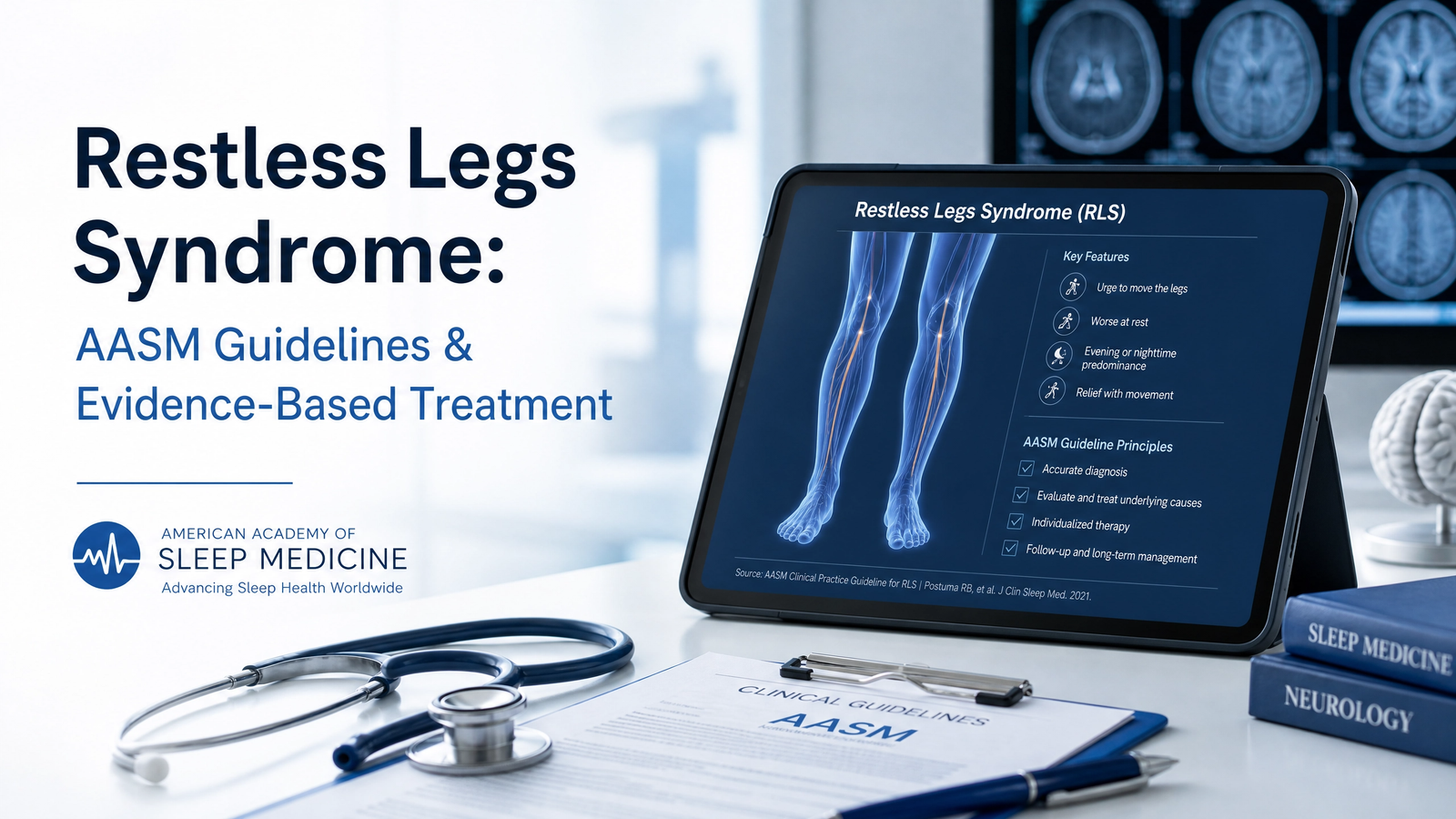

Restless Legs Syndrome: 2024 AASM Guidelines & Evidence-Based Treatment
Understanding the paradigm shift from dopamine agonists to gabapentinoids and iron-centric therapy
The 2024 AASM Guideline Revolution
The 2024 AASM Clinical Practice Guidelines represent the most consequential therapeutic recalibration in RLS history. Comprising 28 evidence-based recommendations, these guidelines have reversed treatment hierarchies based on compelling long-term safety data. Dopamine agonists (pramipexole, ropinirole, rotigotine) have been demoted from first-line to second-line or “conditional” use, while gabapentinoids now occupy the primary therapeutic position.
Why the Shift? The Augmentation Problem
Augmentation is a treatment-induced worsening where prolonged dopamine agonist use paradoxically intensifies RLS. Meta-analyses document augmentation in up to 66% of patients over time. Warning signs include symptoms starting 2+ hours earlier in the day, increased intensity, spread to arms or trunk, and reduced medication response.
| Medication Class | 2024 AASM Recommendation | Key Risk |
|---|---|---|
| Gabapentin Enacarbil | Strong recommendation (first-line) | Dizziness, somnolence, weight gain |
| Gabapentin / Pregabalin | Strong recommendation (first-line) | Dizziness, edema, potential for misuse |
| Dopamine agonists | Conditional (second-line) | Augmentation (66% over time), impulse control disorders |
| Intravenous iron | Strong (ferritin <75 ng/mL) | Infusion reactions, anaphylaxis (rare) |
Interactive Sleep Quality & RLS Assessment
📊 Sleep Quality & RLS Impact Calculator
Understanding Augmentation: Critical Warning Signs
Augmentation is the single most important complication to recognize. If you are taking pramipexole, ropinirole, or rotigotine and notice any of the following, contact your healthcare provider immediately:
- ✅ Symptoms beginning at least 2 hours earlier in the day than before treatment
- ✅ Increased intensity of the urge to move
- ✅ Shorter latency to symptom onset after rest begins
- ✅ Spread of symptoms to arms, torso, or other body regions
- ✅ Paradoxical worsening when medication dose is increased
Frequently Asked Questions
What is the 2024 AASM guideline change for RLS?
The 2024 AASM guidelines recommend gabapentinoids as first-line treatment, moving away from dopamine agonists due to augmentation risk affecting up to 66% of patients over time.
What is augmentation in RLS?
Augmentation is treatment-induced worsening from long-term dopamine agonist use, characterized by earlier symptom onset, increased intensity, symptom spread, and reduced medication response.
Why are gabapentinoids now first-line for RLS?
Gabapentinoids provide robust symptom control without augmentation risk. Clinical trials demonstrate comparable efficacy to dopamine agonists with superior long-term safety profiles.
What iron level is optimal for RLS management?
Clinical guidelines recommend maintaining serum ferritin above 75-100 ng/mL and transferrin saturation above 20% for optimal symptom control.