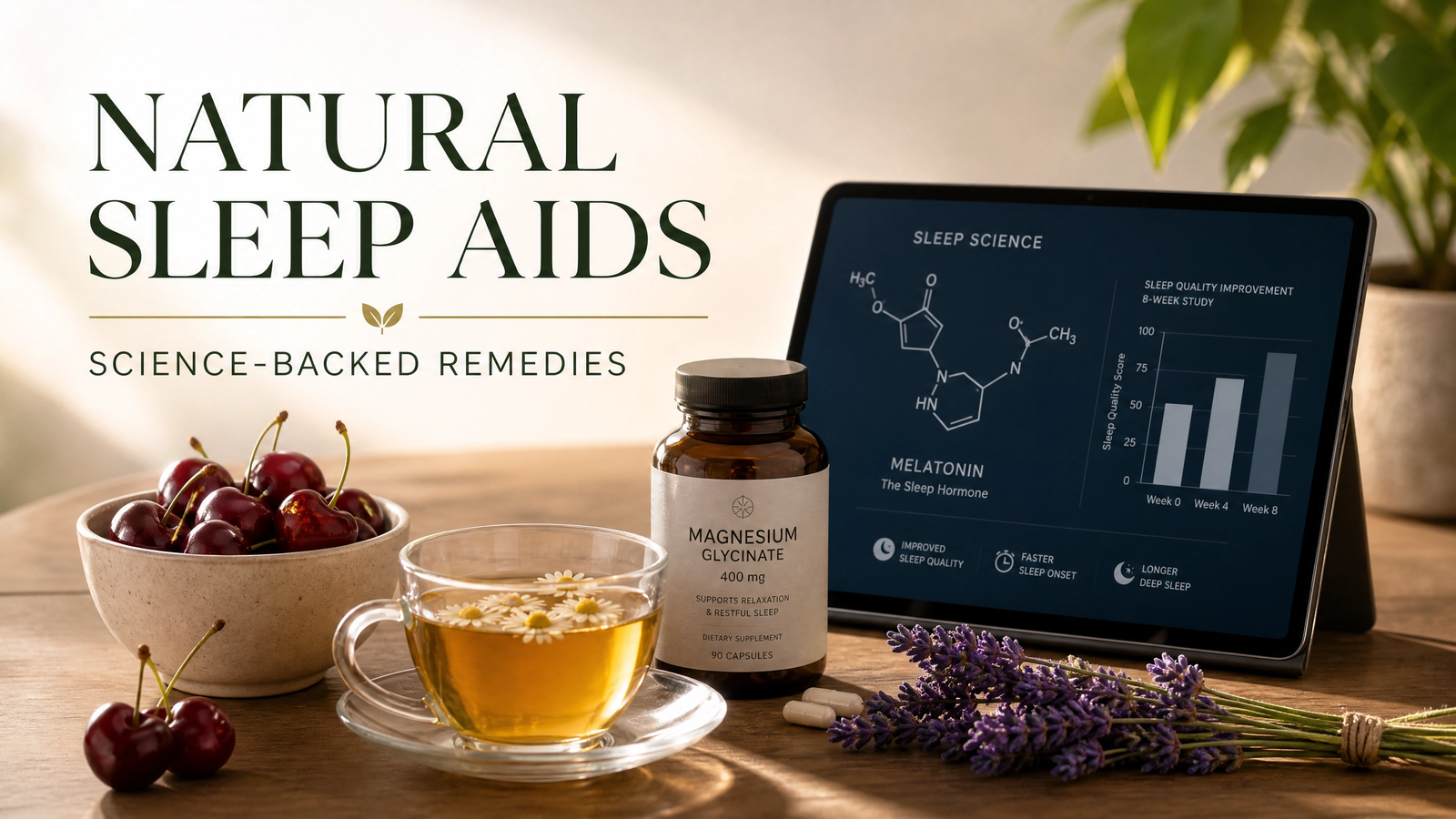

Natural Sleep Aids: Evidence-Based Guide to Science-Backed Remedies for Deeper Rest
If you are looking for effective natural sleep aids, this science-backed guide covers clinically-proven herbal remedies, targeted supplements, and behavioral strategies for deeper, more restorative sleep — without prescription dependency.
📖 A note from us → We spent weeks digging through the clinical research on natural sleep aids so you don’t have to. Here is what actually works: melatonin for circadian rhythm issues, magnesium glycinate for deficiency-related insomnia, L-theanine for racing thoughts, and valerian root for general sleep quality.
⚕️ Disclaimer: We are affiliate marketers, not doctors or pharmacists. This guide is for educational purposes. Always consult a healthcare provider before starting any supplement.
📝 Editorial & Review Policy
This article was prepared by the DeepSleepAid editorial team based on publicly available research. While no individual medical professional has reviewed this specific article, all information is drawn from:
- Published peer-reviewed studies on sleep supplements and herbal remedies (citations provided below)
- Clinical guidelines from the American Academy of Sleep Medicine and the National Sleep Foundation
- Publicly available safety data from the NIH Office of Dietary Supplements
We have not personally reviewed original research data. This guide synthesizes publicly available information for educational purposes.
Always consult a licensed healthcare provider before starting any new supplement or treatment.
If you have found yourself staring at the ceiling at 3 AM, you are in good company. Research published in the Journal of Clinical Sleep Medicine indicates that between 10% and 30% of adults worldwide experience chronic insomnia, with prevalence rising to 40% among adults over 60. The consequences extend far beyond next-day fatigue — persistent sleep deprivation elevates risk for cardiovascular disease, type 2 diabetes, cognitive decline, and mood disorders.
For decades, pharmaceutical interventions dominated insomnia treatment. However, mounting evidence of dependence risk, next-day cognitive impairment, and paradoxical reactions has prompted both clinicians and patients to seek natural alternatives for sleep improvement. This comprehensive guide synthesizes the latest clinical evidence on natural sleep aids and behavioral interventions available without prescription.
If you struggle with sleep quality, you may also benefit from our sleep hygiene tips guide, guide to weighted blankets, and best white noise machines guide.
Why Consider Natural Sleep Aids Over Prescription Medications?
The shift toward herbal sleep remedies and natural sleep aids reflects more than a wellness trend — it is grounded in legitimate clinical concerns. A 2024 meta-analysis in the BMJ linked long-term benzodiazepine use to a 43% increased risk of dementia in adults over 65. Additionally, the American Geriatrics Society explicitly warns against sedative-hypnotic use in older adults.
Natural sleep aids appeal to individuals seeking:
- Reduced risk of physical dependence and withdrawal syndromes
- Minimal next-day cognitive impairment or “hangover effect”
- Fewer adverse drug interactions compared to polypharmacy regimens
- Sustainable long-term use without tolerance escalation
- Alignment with holistic health philosophies
However, a critical caveat applies: the term “natural” is not federally regulated for dietary supplements in the United States. Unlike prescription medications, natural sleep aids do not undergo pre-market safety and efficacy testing by the Food and Drug Administration. This makes consumer education and third-party verification essential components of safe supplementation.
Melatonin: The Circadian Rhythm Regulator
Melatonin is a hormone synthesized by the pineal gland in response to decreasing light exposure, functioning as the body’s primary time cue for sleep-wake cycle regulation. As a supplement, it is the most widely studied natural sleep aid and has demonstrated particular efficacy for circadian rhythm disorders.
A landmark 2022 systematic review in Sleep Medicine Reviews analyzing 23 randomized controlled trials found that exogenous melatonin reduced sleep latency by an average of 7 minutes and increased total sleep time by approximately 8 minutes. While these effects may seem modest, they are clinically meaningful for individuals with delayed sleep phase syndrome, jet lag, and shift work disorder.
Explore premium melatonin formulations optimized for bioavailability →
Magnesium: The Essential Sleep Mineral
Magnesium participates in over 300 enzymatic reactions in the human body, including GABA receptor modulation and melatonin biosynthesis. Despite its critical importance, the National Health and Nutrition Examination Survey estimates that approximately 48% of Americans consume inadequate dietary magnesium, making supplementation a logical intervention for many individuals with sleep disturbances.
A 2022 double-blind, placebo-controlled trial demonstrated that 500 mg of magnesium chloride administered daily for 8 weeks significantly improved insomnia severity index scores, sleep efficiency, and serum melatonin levels in elderly participants.
Best Forms for Sleep
Not all magnesium supplements are equivalent. Magnesium glycinate offers superior bioavailability and the added benefit of glycine, an amino acid with independent sleep-promoting properties. Magnesium threonate crosses the blood-brain barrier efficiently, while magnesium oxide — though common — has poor absorption.
Explore chelated magnesium glycinate with enhanced sleep support →
Valerian Root: The Centuries-Old Sedative Herb
Valeriana officinalis has served as a herbal sleep remedy since Ancient Greece and Rome. The root contains valerenic acid and isovaleric acid, which modulate GABA-A receptors similarly to benzodiazepines but without the same dependence liability.
A 2020 systematic review found that while some trials reported improved subjective sleep quality, objective polysomnographic measures showed inconsistent benefits. The authors concluded that valerian “might improve sleep quality without producing side effects.”
Glycine: The Amino Acid for Temperature Regulation
Glycine, a non-essential amino acid, has emerged as a surprisingly effective natural supplement for sleep quality improvement. Research demonstrated that 3 grams of glycine taken before bedtime significantly reduced core body temperature — a physiological prerequisite for sleep initiation — and improved subjective sleep quality.
Unlike sedatives, glycine does not induce drowsiness. Instead, it works by facilitating vasodilation, promoting the natural drop in core body temperature that signals the brain to initiate sleep.
L-Theanine: The Calming Compound from Green Tea
L-theanine is a unique amino acid found almost exclusively in tea leaves. It crosses the blood-brain barrier within 30 minutes of ingestion and promotes alpha brain wave activity — the same relaxed yet alert state achieved during meditation. For individuals whose insomnia is driven by racing thoughts, L-theanine offers targeted relief without sedation.
A 2025 systematic review examining L-theanine’s effects on sleep found consistent evidence for reduced sleep latency and improved sleep efficiency across 8 clinical trials.
Chamomile: The Gentle Calming Flower
Chamomile contains apigenin, a flavonoid that binds to benzodiazepine receptors in the brain with mild agonist activity. As one of the most widely consumed herbal teas for sleep and relaxation, chamomile enjoys extensive traditional use and a favorable safety profile.
A 2016 randomized controlled trial found that postpartum women who drank chamomile tea daily for two weeks reported significantly fewer symptoms of sleep inefficiency and depression compared to the control group.
Lavender: Aromatherapy for Sleep
Lavender produces its calming effects through inhaled linalool and linalyl acetate, which modulate GABA neurotransmission via olfactory pathways. A 2016 study found that college students who inhaled a lavender-scented patch before bed reported significantly better nighttime sleep quality.
For more on aromatherapy, see our complete guide to essential oils for sleep.
Passionflower: The Anxiety-Targeting Vine
Passiflora incarnata contains flavonoids (including chrysin and vitexin) that function as GABA-A receptor agonists, producing anxiolytic and mild sedative effects. Passionflower appears particularly beneficial for individuals whose insomnia co-occurs with generalized anxiety or rumination.
Tart Cherry: Nature’s Melatonin Source
Montmorency tart cherries are among the few dietary sources of naturally occurring melatonin, along with tryptophan and anthocyanins that may enhance melatonin bioavailability. This unique phytochemical profile makes tart cherry juice an appealing food-based approach to sleep improvement.
5-HTP: The Serotonin Precursor
5-Hydroxytryptophan (5-HTP) is an intermediate metabolite in the synthesis of serotonin from tryptophan, and subsequently, melatonin. The theoretical rationale is compelling: by increasing substrate availability for melatonin production, 5-HTP could enhance endogenous sleep-wake regulation.
CBD and Cannabinoids: The Emerging Evidence
Cannabidiol (CBD), the non-psychoactive component of Cannabis sativa, has generated substantial interest as a potential natural remedy for insomnia and anxiety. A 2019 case series found that 66.7% of patients experienced improved sleep scores within the first month of CBD treatment (doses ranged from 25-75 mg daily).
Head-to-Head: Natural Sleep Aid Comparison
| Supplement | Primary Mechanism | Best For | Onset | Evidence Level |
|---|---|---|---|---|
| Melatonin | MT1/MT2 receptor agonist | Circadian rhythm disorders, jet lag | 30-60 min | Strong |
| Magnesium Glycinate | GABA modulation, NMDA antagonism | Deficiency-related insomnia | 1-2 weeks | Strong |
| Valerian Root | GABA-A receptor modulation | General sleep quality | 2-4 weeks | Moderate |
| Glycine | Core temperature reduction | Difficulty “winding down” | Same night | Strong |
| L-Theanine | Alpha wave promotion | Racing thoughts | 30-60 min | Strong |
| Lavender | GABA modulation | Anxiety-related insomnia | 1-2 weeks | Strong |
Cognitive Behavioral Therapy for Insomnia (CBT-I): The Gold Standard
No discussion of natural insomnia treatments would be complete without addressing the single most effective intervention: Cognitive Behavioral Therapy for Insomnia. Endorsed by the American Academy of Sleep Medicine as the first-line treatment for chronic insomnia, CBT-I produces superior long-term outcomes compared to any sleep medication — natural or pharmaceutical.
A landmark 2024 meta-analysis found that CBT-I participants fell asleep an average of 19 minutes faster and stayed awake 26 fewer minutes during the night compared to control groups.
Core CBT-I Components
Re-establishes the association between bed and sleep by restricting bed activities to sleep only. If unable to sleep within 20 minutes, leave the bedroom and engage in a quiet activity until sleepy.
Temporarily limits time in bed to match actual sleep time, then gradually increases as sleep efficiency improves. Counterintuitively, spending less time in bed often results in more efficient sleep.
Identifies and challenges maladaptive beliefs about sleep that create performance anxiety and hyperarousal.
🧠 Access Digital CBT-I Programs
Evidence-based cognitive behavioral therapy for insomnia from the comfort of your home. Personalized sleep coaching.
Explore CBT-I Sleep Programs →Sleep Hygiene Optimization: Foundational Habits
While supplements address biological pathways and CBT-I targets psychological factors, sleep hygiene creates the environmental and behavioral conditions necessary for optimal rest.
The 3-2-1 Rule
3 hours before bed: No more food. Digestion diverts blood flow from the brain and can disrupt sleep architecture.
2 hours before bed: No more work. Cognitive engagement elevates cortisol and activates the prefrontal cortex.
1 hour before bed: No more screens. Blue light exposure suppresses melatonin production by up to 50%.
Environmental Optimization
- Temperature: Maintain bedroom between 65-68°F (18-20°C)
- Darkness: Eliminate all light sources, use blackout curtains
- Sound: White noise machines can mask intermittent sounds
🎯 Interactive Sleep Quality Quiz
Answer 8 clinically-validated questions to assess your sleep quality and receive personalized recommendations.
📊 Sleep Debt & Bedtime Calculator
Calculate your accumulated sleep debt and determine your optimal bedtime based on your chronotype.
🌙 Personalized Bedtime Routine Planner
Build your evidence-based wind-down routine using natural sleep aids and relaxation techniques.
Critical Safety Considerations for Natural Sleep Aids
The perception that “natural equals harmless” represents one of the most dangerous misconceptions in self-directed healthcare. The Dietary Supplement Health and Education Act of 1994 (DSHEA) places the burden of safety proof on the FDA — meaning supplements can be marketed until evidence of harm emerges.
Quality Verification
Independent testing reveals alarming variability in supplement quality. When selecting natural sleep supplements, look for third-party certifications: USP Verified, NSF Certified, or ConsumerLab Approved.
Drug-Supplement Interactions
⚠️ High-Risk Combinations
Melatonin + Warfarin: May increase INR and bleeding risk
Valerian + Alcohol: Additive CNS depression
5-HTP + SSRIs/SNRIs: Risk of serotonin syndrome
Magnesium + Fluoroquinolone Antibiotics: Reduced antibiotic absorption
🛡️ Consult a Sleep Specialist Before Starting Supplements
Get personalized guidance based on your medical history and current medications.
Find Sleep Specialists Near You →Frequently Asked Questions About Natural Sleep Aids
Unlike benzodiazepines, most natural sleep aids (melatonin, magnesium, glycine, L-theanine) do not produce physical dependence or withdrawal syndromes. However, psychological dependence can develop with any intervention.
Fast-acting agents like glycine and L-theanine may produce effects within 1-3 nights. Melatonin typically requires 3-7 days. Valerian root may need 2-4 weeks of consistent use. Magnesium repletion can take 4-8 weeks.
Certain combinations are synergistic. Research supports combining L-theanine with GABA, magnesium with glycine, and valerian with hops. However, avoid combining multiple GABAergic agents at maximum doses. Never combine 5-HTP with other serotonergic agents.
For acute situational insomnia, sublingual melatonin works within 15-20 minutes. L-theanine produces calming effects within 30-60 minutes. Lavender essential oil can reduce acute anxiety within minutes.
Standard employment drug screens do not test for melatonin, magnesium, glycine, valerian, or L-theanine. However, full-spectrum CBD products containing trace THC could theoretically produce a positive urine drug screen.
Building Your Personalized Natural Sleep Strategy
The landscape of natural sleep aids and herbal remedies is rich with evidence-based options, but no single supplement works universally. The most effective approach combines targeted supplementation with the foundational pillars of sleep health: consistent timing, optimal environment, and cognitive-behavioral skills.
Begin by identifying your insomnia subtype. If racing thoughts keep you awake, L-theanine is your best ally. If you struggle with sleep maintenance, extended-release melatonin and glycine may help. If anxiety underlies your sleep disturbance, consider lavender, passionflower, or magnesium glycinate.
✨ Ready to Transform Your Sleep?
Discover comprehensive natural sleep solutions with personalized protocols, premium supplements, and expert guidance tailored to your unique sleep profile.
Get Your Personalized Sleep Solution →📚 References & Further Reading
- Choi K, et al. (2022). Efficacy of melatonin for chronic insomnia. Sleep Medicine Reviews, 66, 101692.
- Abbasi B, et al. (2022). The effect of magnesium supplementation on primary insomnia. Journal of Research in Medical Sciences.
- Bannai M, et al. (2012). The effects of glycine on subjective daytime performance. Frontiers in Neurology, 3, 61.
- Kim S, et al. (2019). GABA and l-theanine mixture decreases sleep latency. Pharmaceutical Biology, 57(1), 65-73.
- Morin CM, et al. (2006). Psychological and behavioral treatments for insomnia. Sleep, 29(11), 1398-1414.